
Call Us: +27 63 169 8798


pH of Calcium Hypochlorite
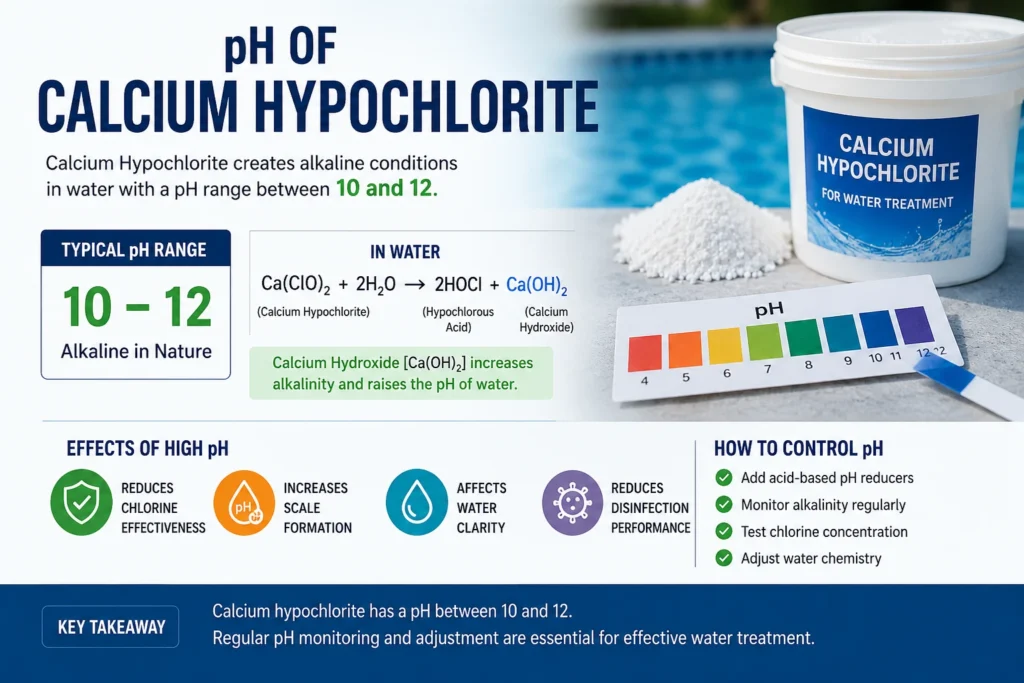
Calcium hypochlorite has a high pH and usually creates alkaline conditions when dissolved in water. In most applications, calcium hypochlorite solutions have a pH range of 10-12, depending on concentration and water conditions.
Because of its alkaline nature, calcium hypochlorite can increase water pH in swimming pools, drinking water systems, and industrial treatment applications.
🔹 What is Calcium Hypochlorite?
Calcium hypochlorite is a chlorine-based chemical widely used for:
- Water purification
- Swimming pool sanitation
- Wastewater treatment
- Industrial disinfection
Its chemical formula is:
Ca(ClO)2Ca(ClO)_2Ca(ClO)2
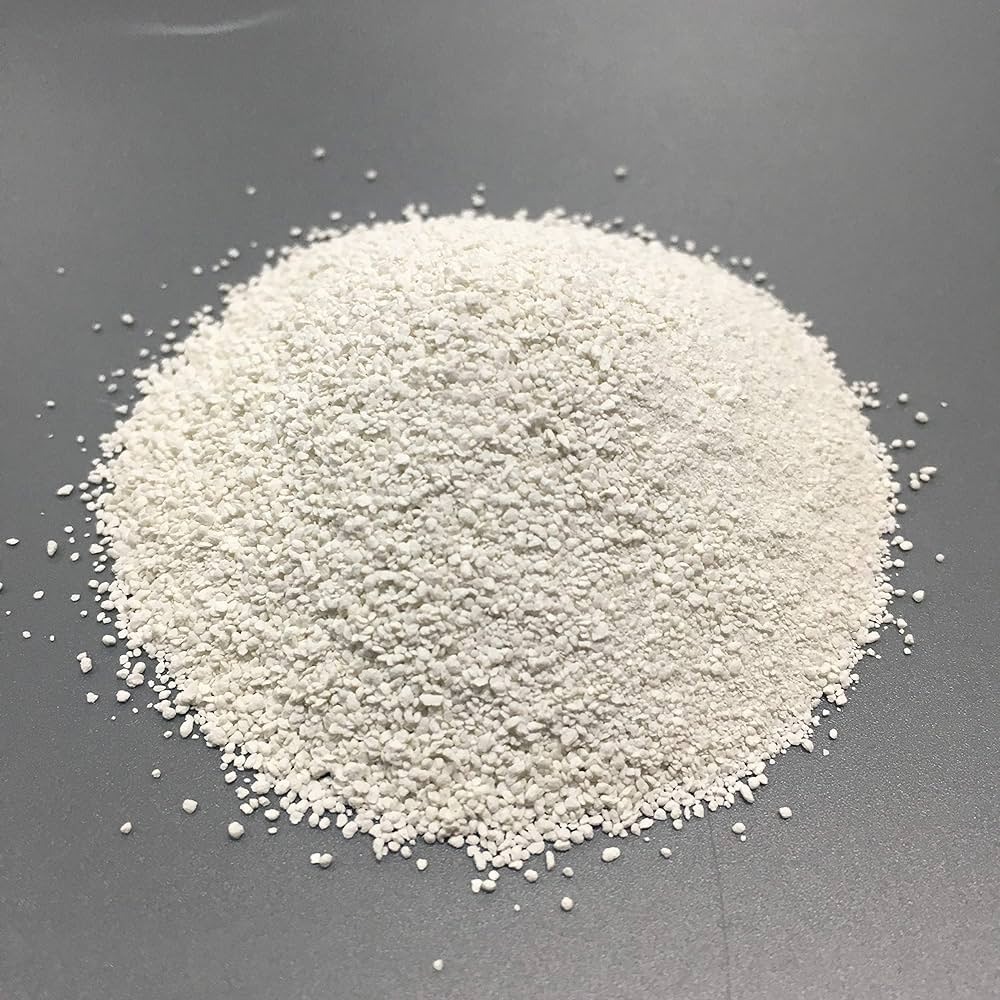
The chemical usually appears as white granules or powder with strong oxidizing properties.
What is the pH of Calcium Hypochlorite?
Calcium hypochlorite typically produces alkaline solutions with a pH between:
10≤pH≤1210 \leq pH \leq 1210≤pH≤12
The exact pH depends on:
- Concentration
- Water composition
- Temperature
- Treatment conditions
As a result, operators often monitor pH levels carefully during water treatment.
Why Calcium Hypochlorite Raises pH
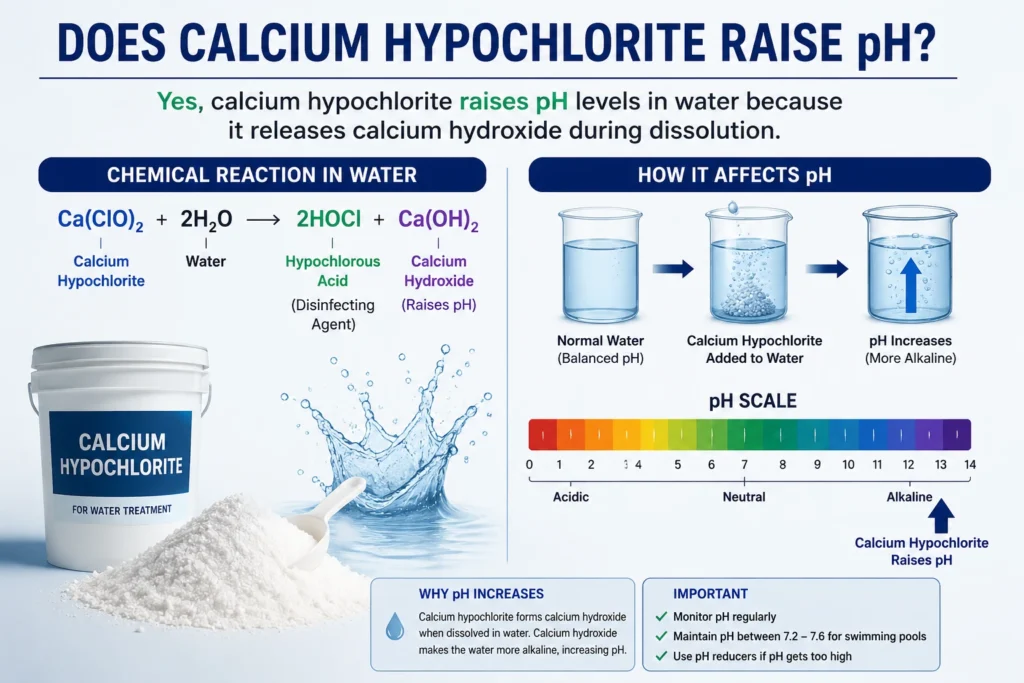
Calcium hypochlorite raises pH because it produces calcium hydroxide when dissolved in water.
The simplified chemical reaction is:
Ca(ClO)2+2H2O→2HOCl+Ca(OH)2Ca(ClO)_2 + 2H_2O \rightarrow 2HOCl + Ca(OH)_2Ca(ClO)2+2H2O→2HOCl+Ca(OH)2
During this process:
- Hypochlorous acid provides disinfection.
- Calcium hydroxide increases alkalinity and pH.
Consequently, water becomes more alkaline after treatment.
Effects of High pH in Water
High pH levels can affect water treatment efficiency and water balance.
High pH may:
- Reduce chlorine effectiveness
- Increase scale formation
- Affect water clarity
- Reduce disinfection performance
Therefore, operators regularly test and adjust pH levels after chlorination.
Calcium Hypochlorite in Swimming Pools
Pool operators commonly use calcium hypochlorite because it:
- Kills bacteria and algae
- Maintains chlorine levels
- Improves pool sanitation
However, calcium hypochlorite can also increase:
- pH levels
- calcium hardness
- alkalinity
As a result, pool owners often use pH reducers to maintain balanced pool water.
How to Control pH After Using Calcium Hypochlorite
Water treatment operators and pool owners use several methods to control pH levels.
Common pH control methods include:
- Adding acid-based pH reducers
- Monitoring alkalinity regularly
- Testing chlorine concentration
- Adjusting water chemistry
Consequently, balanced pH improves disinfection efficiency and water quality.
Benefits of Calcium Hypochlorite
Despite its alkaline properties, calcium hypochlorite remains widely used because it provides:
- Strong disinfecting power
- Highly available chlorine content
- Fast microbial control
- Long shelf life
- Effective water purification performance
Because of these advantages, industries worldwide continue to use calcium hypochlorite in water treatment systems.
Calcium Hypochlorite for Water Purification
Industries and municipalities widely use calcium hypochlorite in:
- Drinking water treatment
- Swimming pools
- Industrial sanitation
- Wastewater treatment systems
👉 Learn more about our
Calcium Hypochlorite for Water Purification product page:
Calcium Hypochlorite for Water Purification product page:
Related Water Treatment Resources
👉 Read more about:
👉 Learn more about:
🔹 Conclusion
Calcium hypochlorite typically produces alkaline water with a pH of 10-12. Because it releases calcium hydroxide during dissolution, it can increase water alkalinity and pH levels.
Although operators must closely monitor water balance, calcium hypochlorite remains one of the most effective chemicals for water purification and swimming pool sanitation.
FAQ Section
What is the pH of calcium hypochlorite?
Calcium hypochlorite solutions usually have a pH of 10-12.
Does calcium hypochlorite increase pH?
Yes, calcium hypochlorite increases pH because it reacts with water to produce calcium hydroxide.
Why does calcium hypochlorite raise alkalinity?
It releases calcium hydroxide during dissolution, which increases alkalinity and water pH.
What is the chemical formula of calcium hypochlorite?
Ca(ClO)2Ca(ClO)_2Ca(ClO)2
The chemical formula of calcium hypochlorite is Ca(ClO)₂.